

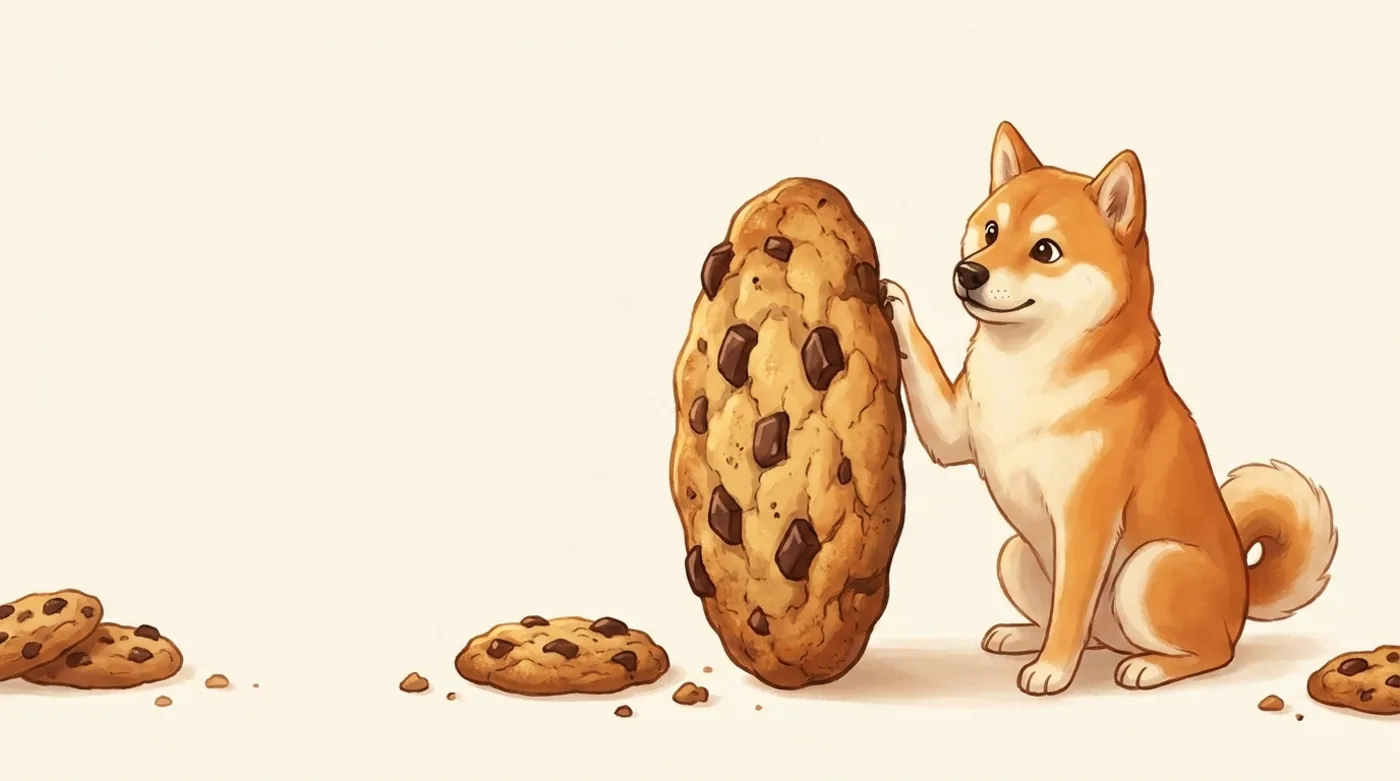
A New York style cookie, also called a Levain style cookie, is a 150-200 gram cookie that is crisp around the edge and deliberately underbaked in the middle. Not flat, not dry, not evenly cooked through. All of that is on purpose.
Most cookie advice treats a thick cookie with a wet centre as a fault to correct. It is not a fault. It is a different genre with its own rules.
Where it came from
In the mid-90s two friends from New York, Connie McDonald and Pam Weekes, opened a small bakery on the Upper West Side. They had met swimming and were training for triathlons together. By their own account the huge, calorie-dense cookie came out of exactly that: something you could eat after a training session and be full.
That story comes from the bakery itself and nobody has independently checked it, so treat it as house legend.
What is documented is this. In October 1997 The New York Times wrote about the bakery and called the cookie the largest in Manhattan. The weight given was six ounces. That is about 170 grams, close to half a pound of cookie.
Ours weighs exactly that. Not because it is a tidy number, but because it is the size the whole style started at.
Why it is thick and not flat
A thin cookie spreads in the oven. A thick one runs out of time. The difference is not the recipe, it is what happened to the dough before it went in.
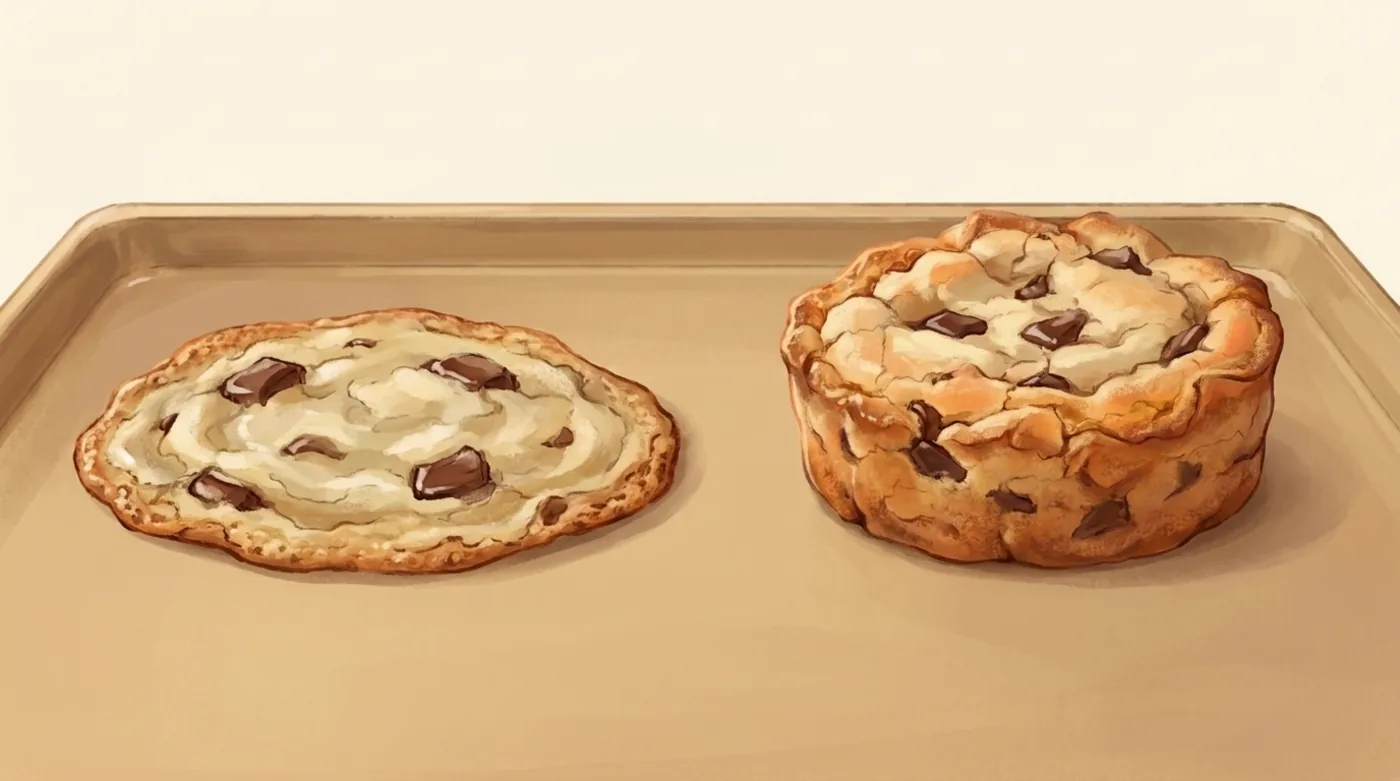
Four things work at once:
- Cold dough and cold butter. While the butter is still solid it holds its shape. Warm butter runs before the egg proteins can set, and the cookie spreads. King Arthur Baking ran the comparison directly: dough chilled even half an hour spreads noticeably less, and after a day it also bakes darker and tastes stronger, because it dries slightly and the flavour concentrates.
- Flour with real protein in it. Gluten is the frame that holds the height. Weak flour never builds the frame.
- A big ball, left alone. It starts tall, so even normal spread leaves it thick. Flattening the ball before baking is the single most common way to destroy the style.
- A hot oven and a short bake. The crust sets faster than the middle heats through. Research published by the Institute of Food Technologists found around 205C gives the best balance between structure and moisture loss. That is a good deal hotter than the 170-180C an ordinary cookie gets.
Crisp outside, molten inside
Put those together and a broken cookie shows three zones at once rather than one.
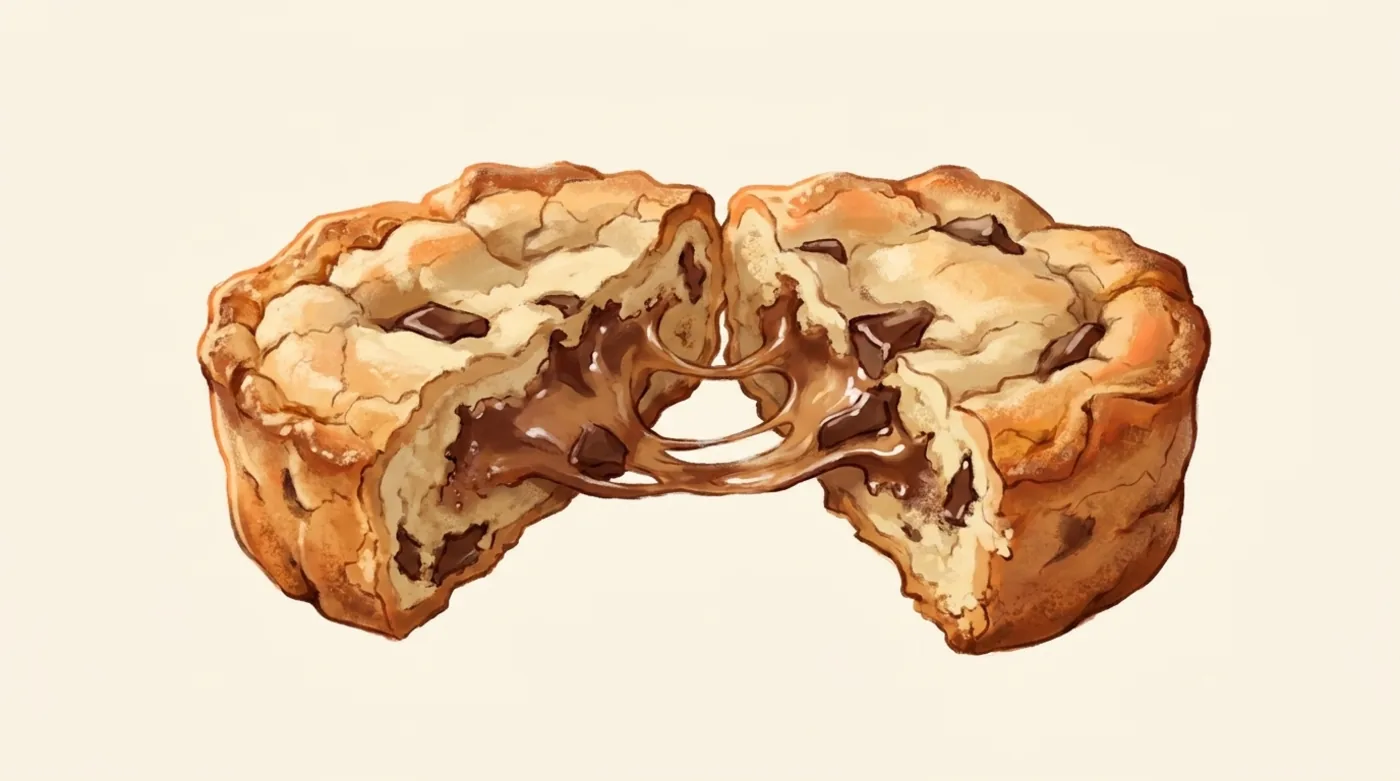
Crisp crust on the outside. A baked but tender ring under it. In the middle, a soft centre that pulls when you break it. That centre is the reason people tear these in half instead of biting them.
Why chunks and not chips
This is not about chunks being fancier. They are different products built for different jobs.
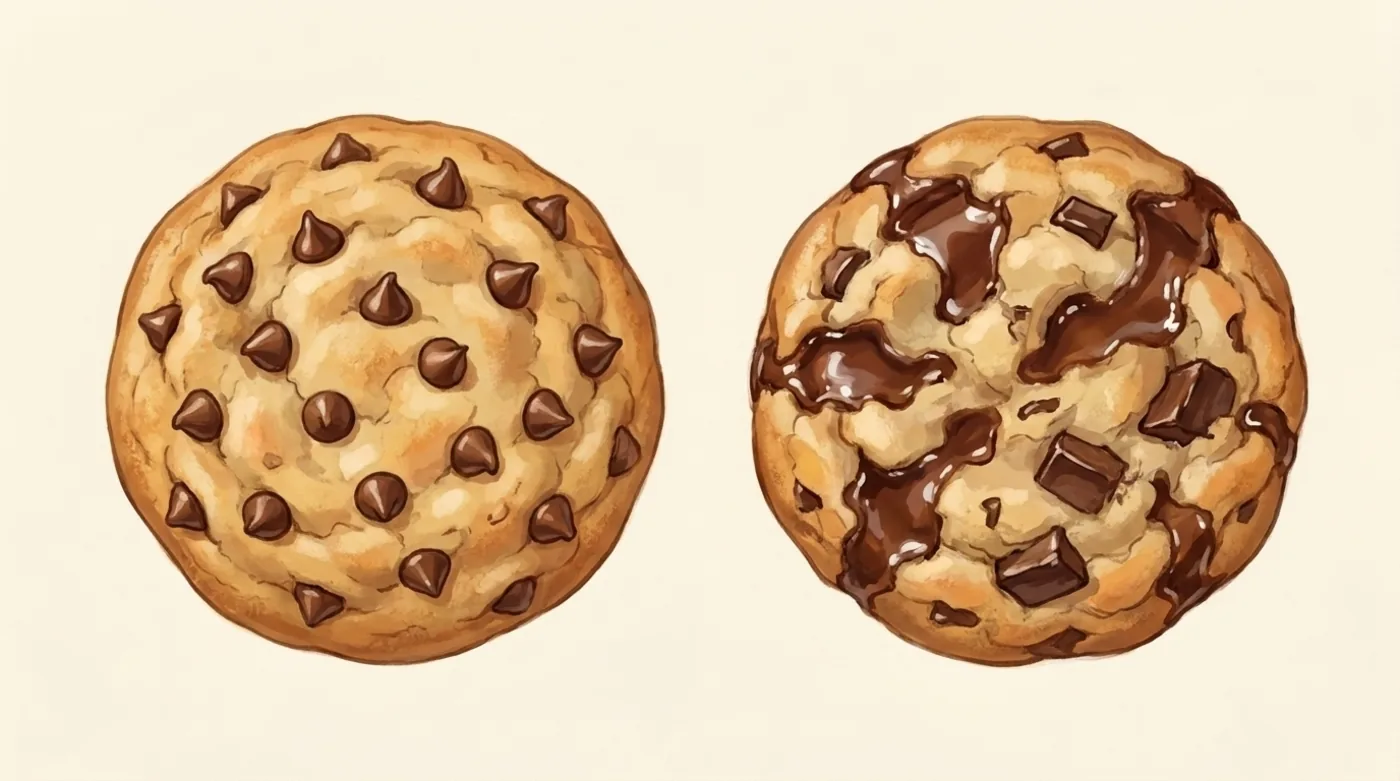
Chocolate chips are formulated not to melt: less cocoa butter, plus an emulsifier. They come out of the oven as neat little drops. That is useful for industrial baking and for photographs, but nothing stretches when you break the cookie.
Chunks were never built to fight an oven. More cocoa butter, so they run, and they leave dark pools and streaks through the crumb. King Arthur Baking puts it plainly: if you want melted chocolate rather than chips, chop a bar.
Against an ordinary cookie
| Ordinary cookie | New York style | |
|---|---|---|
| Weight | 30-50 g | 150-200 g |
| Thickness | Flat | 3-4 cm |
| Middle | Baked through | Soft, molten |
| Chocolate | Chips | Chunks |
| Oven | 170-180C | Around 205C |
| Bake time | 15-20 min | 9-11 min |
| Eaten in one sitting | Three or four | One, if that |
That last row matters most. This is not a cookie about quantity. One with coffee is dessert, not a snack.
Three rules that are wrong here
If you have baked cookies from an ordinary recipe, three habits have to go. This is what people who have baked this style hundreds of times say, rather than lab science.
- “Use room temperature butter.” True for ordinary cookies. Here it is the opposite: the butter needs to be cold, or it melts before any structure exists to hold.
- “Use low protein flour for tenderness.” Also backwards. Weak flour gives a soft, cakey cookie that cannot hold height. Ordinary flour holds better.
- “Flatten the ball so it bakes evenly.” An evenly baked cookie is exactly what this style is not. The ball goes in tall and rough.
How we bake ours
Six flavours, 170 grams each.
Butter only, no margarine and no palm oil. The dough rests for a full day before baking: the flour finishes absorbing the water, the dough dries slightly, and the flavour deepens. That is the same effect King Arthur measured, on our schedule.
The dough is then portioned and frozen, and baked on the day the parcel goes out. Most bakeries in this style work that way, and not only for convenience: a frozen ball in a hot oven sets on the outside faster still, so the cold is working for height even harder than a fridge does.
The flavours: chocolate and walnut, double chocolate, blueberry muffin, peanut crisp, honey cornbread, and oatmeal raisin. Once a month a seventh appears, the drop flavour, voted for by Cookie Club members.
Everything we bake is the dry kind, with no cream. That is a decision rather than a limit: a cookie like this reaches any city by post in one piece. Why, and what happens to the box on the way, is in a separate post.
How to eat it
Warm is best. Thirty seconds in a microwave, or three to four minutes in an oven at 150C, and the chocolate inside goes liquid again.
Cold works too, it is just a different cookie: denser, closer to a brownie.
Kaiju, our chief taste officer, recommends warm. Kaiju recommends everything.
Boxes of 2, 4, 8 and 12 are here. Delivery is free from 6 cookies.