

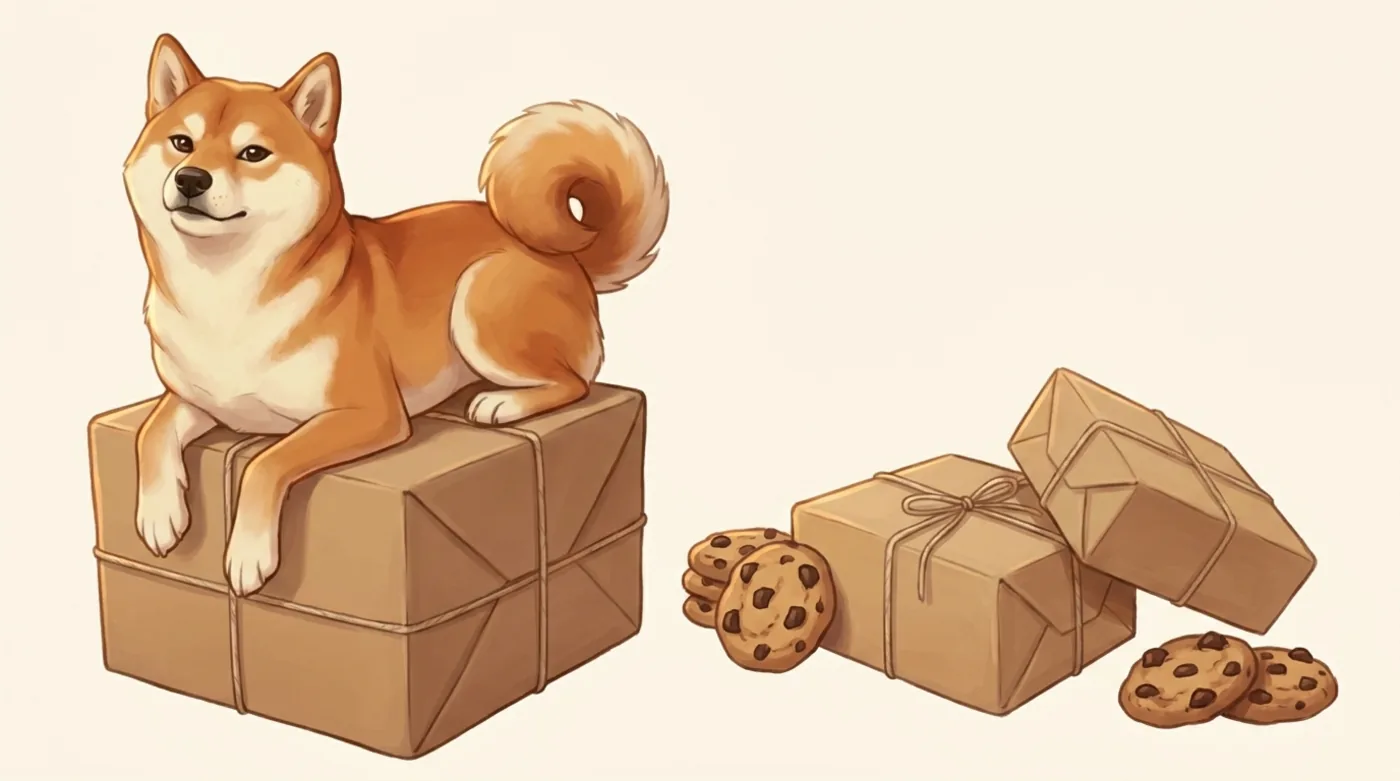
A cookie that tastes good in the kitchen and a cookie that tastes good after two days in transit are two different products. The second one is designed at the recipe stage, not at the packing bench.
Here is what happens to your box between our oven and your pickup point.
Can cookies be posted at all
Yes, but not every cookie. Nova Poshta’s rules name what cannot go:
Food that requires a special temperature regime, or has a shelf life under 5 days (storage times must be stated on the packaging), plus chilled or frozen products and dairy.
Three things follow from that:
- The shelf life has to be printed on the pack. Not a nice-to-have, a condition. Every box of ours carries 10 days.
- It has to beat 5 days. Ten clears it twice over.
- There can be no temperature requirement. Nova Poshta does not carry cold and does not claim to. Anything needing a fridge travels at the sender’s risk, and that risk is real.
Which is why we make one kind of cookie: dry, no cream, nothing that has to stay cold.
Why dry cookies and nothing with cream
This is microbiology, not preference, and the numbers are blunt.
Cream-filled things belong to the category of food that has to live in a fridge. The US food safety regulator FSIS names cream-filled pastries directly in that category and gives the rule: between roughly 4C and 60C bacteria double every 20 minutes, and ready-to-eat food of that kind is treated as unsafe after 4 hours out of refrigeration.
A parcel is in transit for 1 to 2 days. That is 24 to 48 hours, six to twelve times the limit.
A dry cookie is not in that category at all, and the reason is how much of its water is free. There is a measure called water activity. It describes not how much moisture a food contains but how much of it is available to bacteria. Sugar binds water to itself through hydrogen bonds; fat dilutes the rest. Below 0.6 bacteria cannot grow at all, fridge or no fridge. A dry, sugar-heavy, butter-heavy cookie sits below that line.
That is the whole answer to why one product can go in a parcel and another cannot. It is arithmetic, not caution.
How long they actually keep
The box says 10 days. The interesting part is what changes over those days.
Bread and cookies go stale by different mechanisms. Bread stales through starch retrogradation, the starch slowly recrystallising. A cookie does not have enough water for that to matter; what water there is gets competed for by sugar and fat. So a cookie stales almost entirely through moisture moving - the surface drying out, or drawing moisture in from the air, and the texture shifting with it.
Fat going rancid, which is what makes genuinely old cookies taste bad, runs on a scale of months. A study tracking oxidation in cookies over 15 months shows a slow climb, not a cliff in week two.
The practical version: one or two days in transit is nowhere near long enough for anything to happen. The shelf life is limited by texture, not by safety.
How the box is built
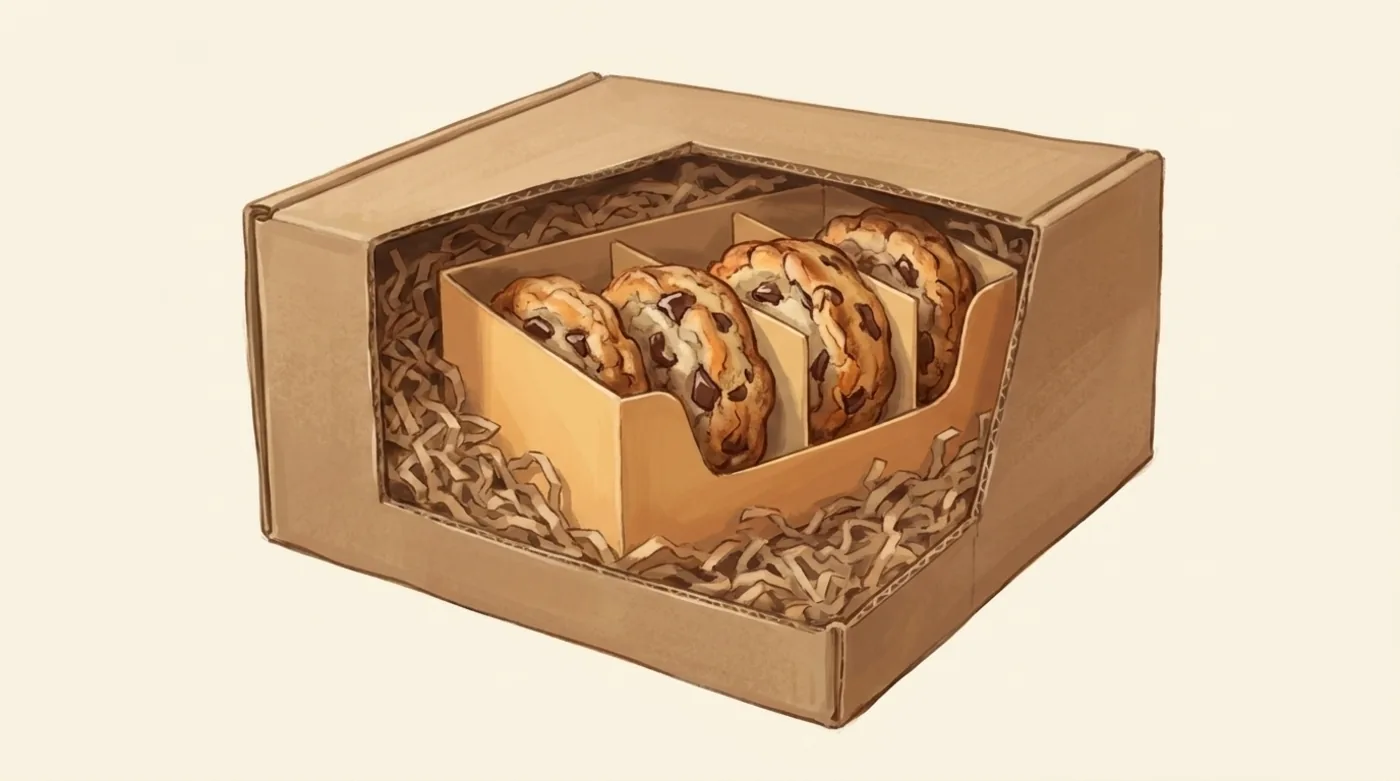
In order:
- The cookies cool completely. Not a formality, and there is a section on it below.
- Each cookie sits on its own, divided, so they cannot rub or knock against each other.
- The branded box goes inside a kraft outer, and every gap between them gets filled. Empty space is the main cause of crumbs: it gives a heavy cookie room to build speed before it hits a wall.
- The shake test. Close the box but do not tape it, then shake. If anything rattles, it needs more fill. King Arthur Baking recommend exactly this, and it beats any amount of theory.
We pack on the day of dispatch, not in advance.
Why they have to cool first
The least obvious step and the most important one.
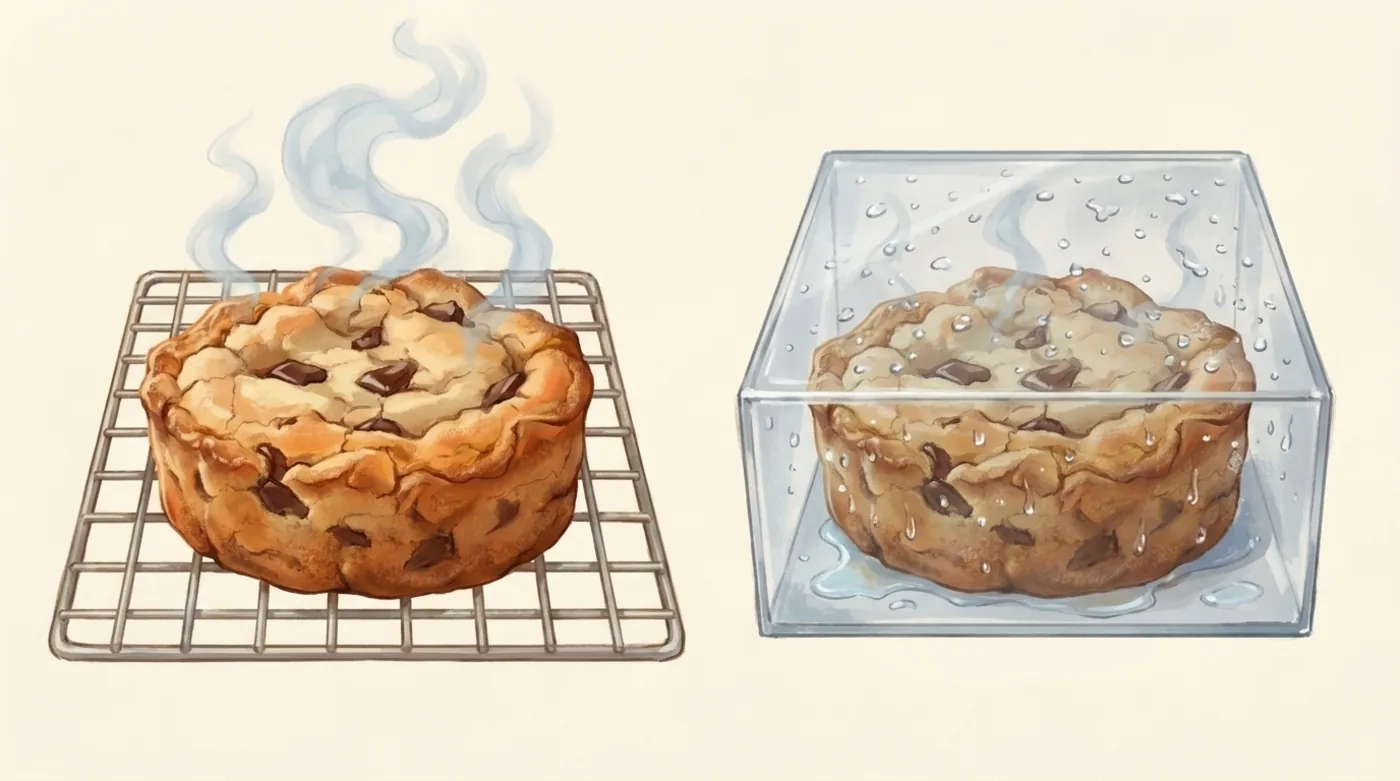
A warm cookie releases steam. Seal it in a box straight away and that steam has nowhere to go: it condenses on the walls and goes back into the cookie. The crust, which the whole bake was for, softens within hours.
So they stand on a rack until they are properly cold, and only then go in the box.
Branch or locker
You pick one at checkout, and the difference matters more than it looks.
A branch works every time and for any box. The parcel is handed over against an ID, which is why checkout asks for a first and last name. That is Nova Poshta’s requirement, not our form design.
A locker is quicker and has no queue, but it has physical limits. Nova Poshta accept parcels up to 40x60x30 cm and 20 kg at a locker. Our boxes are well inside that, so the question is not size but whether a free cell of the right size happens to be there.
If in doubt, take the branch. It never lets you down.
How long it takes
Usually under a day inside one city. Between larger cities across Ukraine, 1 to 2 days. Longer to places Nova Poshta does not serve daily, and across weekends and holidays.
We ship on baking day. Against a 10-day shelf life that means the cookies reach you with about a week still in hand.
If the box arrives damaged
Write to [email protected] with a photo.
The cookies are heavy, 170 grams each, and parcels get dropped at sorting. Sometimes something breaks, and that is our problem rather than yours. We either send a replacement or refund you.
What we will not do is argue about whether you dropped it yourself.
We wrote about the cookie itself, and why it is so thick, over here. The boxes that ship free are here.